
Harrison County Civil Docket Searches
Harrison County runs its civil docket search through two separate CaseLook portals. County Court CaseLook is the start for limited civil complaints through $15,000. Small claims run through $6,000. Eviction matters sit there too. Common Pleas CaseLook is the route for the larger civil cases. It also holds Domestic Relations, judgment liens, and related Common Pleas records. Both portals are free to open after their notices. Neither one makes the displayed screen a certified court record. Nor does either promise every document image. County Court accepts a Party or Company Name, a numeric case number, or a Hearing Date. File Date and a case-family filter work too. Common Pleas permits one search criterion at a time and puts a CAPTCHA before results. Begin with the court that matches the claim type and amount. Still unsure? Run both portals. A County Court civil action can be transferred to Common Pleas when a counterclaim exceeds the County Court limit.
- Classify the matter by amount and type before choosing County Court or Common Pleas.
- Search the matching CaseLook portal by party name, numeric case number, or date, then limit the case family only when needed.
- Open the matching record and read the first filing, service or return entries, hearings, motions, and the newest judgment-related entry in date order.
- Use the calendar only to check a current setting; a scheduled event is not the judgment entry.
- Contact County Court at 740-942-8865 or the Common Pleas Clerk at 740-942-8863 for a direct-access question, a plain copy, or a certified copy.
Harrison Civil Jurisdiction Lines
What a case is worth, and what it is about, points to the likely docket. Harrison County Court handles civil complaints up to $15,000. Small claims stop at $6,000. Evictions go there too. Anything above $15,000 belongs to the Common Pleas General Division. Common Pleas CaseLook also sorts its records into Civil, Domestic Relations, and Judgment Lien categories. The right checkbox depends on the kind of record. It is not just about the word civil.
| Matter | Likely docket | Search or custodian |
|---|---|---|
| Civil claim at or below $15,000 | Harrison County Court | County Court CaseLook and the County Court clerk. |
| Small claim at or below $6,000 | Harrison County Court | County Court CVI group and the small-claims counter. |
| Eviction or forcible entry and detainer | Harrison County Court | County Court CaseLook, counter, and court forms. |
| Civil dispute over $15,000 | Common Pleas General Division | Common Pleas CaseLook Civil (CV) and the Clerk. |
| Domestic Relations or judgment lien | Common Pleas | Common Pleas DR or JL, subject to applicable access limits. |
These divisions keep a search from coming up empty for the wrong reason. Start at County Court with a large civil claim and you may see no record there. The case simply sits in Common Pleas. The reverse trips up small claims and evictions. Those belong at County Court.
Civil Dockets: What They Show
The County Court civil layout splits Civil and Small Claims apart into separate record families. What shows up varies by case type. A record may list the civil case number or family. Docket Entries, filed-case activity, hearing events, and service or return activity can appear as well. Judgment entries, payment or deposit fields where recorded, and post-judgment activity can appear too. An entry tells you an event occurred. It does not put the filed document itself online. The clerk holds the actual order or a certified copy.
| Case number and family | The court header identifies the record. County Court groups CVE, CVF, CVG, CVH, and CVT as Civil, with CVI separate for Small Claims. |
|---|---|
| Parties and claim | The caption and initial filing identify the plaintiff and defendant or other parties, along with the claim information placed in the record. |
| Service activity | Summons, service, and return entries show procedural notice activity rather than a decision on the claim. |
| Settings and motions | Hearing and motion entries show scheduled court events; confirm the newest entry after a reset. |
| Judgment activity | A judgment entry records the ruling. Satisfaction and appeal-related entries can follow later. |
Read a county docket as a sequence. The complaint, service effort, response, setting, hearing, judgment, and satisfaction each answer a different question about the case.
Harrison Civil Case Families
The County Court portal labels its five Civil Cases families CVE, CVF, CVG, CVH, and CVT. CVI sits apart as Small Claims Cases. That grouping works well as a search aid. But the court publishes no decoder that ties each civil label to one particular claim type. So don't stretch the letters into invented case descriptions.
- CVE / CVF / CVG / CVH / CVT
- County Court CaseLook groups labeled Civil Cases.
- CVI
- The separate County Court CaseLook group labeled Small Claims Cases.
- CV
- The Civil checkbox in Common Pleas CaseLook for General Division civil work.
- JL
- The Common Pleas CaseLook category for a Judgment Lien record.
- DR
- The Common Pleas CaseLook category for Domestic Relations, where access can have additional limits.
With a County Court number, follow the form's numeric-case instruction. Common Pleas wants numbers only. Never mix a number search with a name search in one query. These habits help you find the public register. They say nothing about whether every civil file has been digitized. The same goes for attachments. They do not promise a downloadable file on each docket line.
What Cases Fill the Civil Docket
Harrison County sorts its civil records by court level and by subject. County Court dockets hold limited claims, small claims, and evictions. Common Pleas Civil covers disputes above that limit. Its clerk keeps separate categories too. Domestic Relations and Judgment Lien sit apart. The header and category matter in any civil lookup.
- Limited civil complaints at or below the County Court’s $15,000 jurisdictional line.
- Small claims seeking money at or below $6,000, exclusive of interest and costs.
- Eviction or forcible entry and detainer matters in County Court.
- General Division civil disputes above $15,000 in Common Pleas Civil (CV).
- Domestic Relations and Judgment Lien records in their separate Common Pleas categories.
Cases do not stay put. A counterclaim above $15,000 sends the case up. County Court must then certify the action to Common Pleas with the original papers and a certified transcript of journal entries. A docket can look stalled when it really moved. Search the original County Court record and the Common Pleas Civil record whenever a case seems to have changed courts.
Harrison Small Claims Filing Path
Harrison County's published Small Claims Complaint gives useful background for reading a CVI docket. The form covers recovery of money. It caps the local small-claims remedy at $6,000, exclusive of interest and costs. Party details, a statement of claim, the amount, and interest information all get filled in. So do a signature and an oath. The clerk assigns a case number. That filing path explains the docket's order. The complaint comes first, then service or notice activity, a hearing setting, and later judgment or dismissal entries.
| Published small-claims instruction | Local detail |
|---|---|
| Claim under $1,000 | $50 filing cost. |
| Claim from $1,000 through $6,000 | $85 filing cost. |
| Hearing window | Scheduled no sooner than 20 and no later than 40 days after filing. |
| Mail filing | Sign before a notary and include two extra copies plus a check or money order. |
Those lines are filing instructions, and CaseLook does not care about them when you search. The docket event itself is what counts. It shows the date actually set, whether service went through, the judgment, or its satisfaction. One more thing the instructions cover is appeals. Either side has 30 days from the court entry to appeal. The route runs through the Seventh District. Harrison County Court’s official forms page is where the local civil and small-claims forms live.
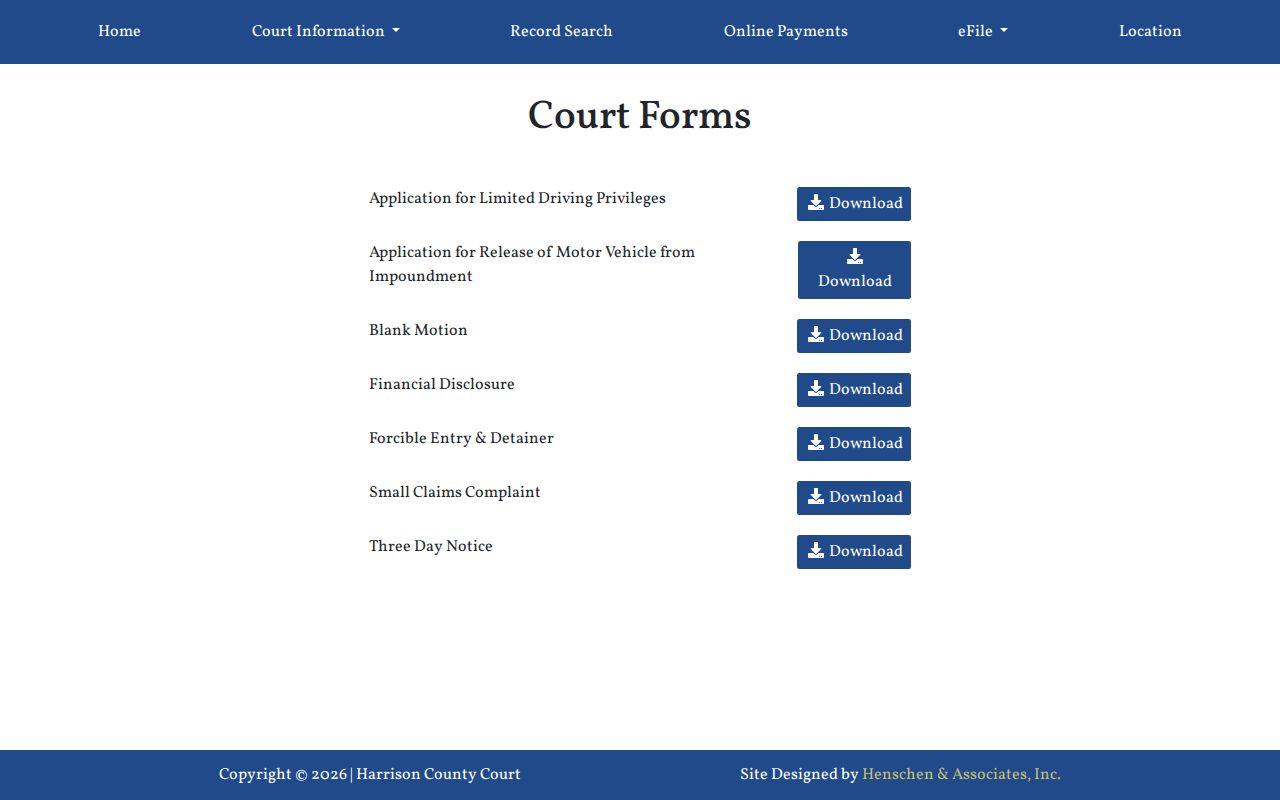
Forms explain how to file. For a particular civil docket and its current record status, CaseLook and the clerk remain the places to look.
Hearings on the Civil Docket
A hearing row or motion setting on a civil docket means one thing. The court put an event on its calendar. It is not a judgment. A signed judgment entry is a separate ruling. Only the case record supplies the filing history and Docket Entries behind it. County Court’s public calendar and schedule work well for checking a current listing. Common Pleas runs its own Calendar Search interface. Dates can shift, too. After a continuance or reset, a newer docket entry replaces the earlier calendar date. The freshest entry wins.
Read a civil record in sequence. Complaint filed first. Then comes service or return, answer or motion, setting notice, and hearing. After that, a judgment-related entry, and finally any satisfaction or appeal activity. Each row does one job. A return of service only proves notice, and a hearing row only names an event. The judgment entry is the court’s ruling in the file. For the signed order itself, ask the clerk for an actual copy.
CaseLook for County Court carries a warning worth noting. Displayed data can lag court action by at least 24 hours. If a setting just moved, or the portal disagrees with a mailed notice, confirm directly. County Court answers at 740-942-8865, and Common Pleas staff at 740-942-8500.
Harrison Civil Transfer Records
A transfer can make a Harrison County civil docket search look incomplete. That happens when you only check one court. Ohio law says a civil action with a counterclaim over $15,000 gets certified to Common Pleas. The original papers go with it. A certified transcript of the journal entries travels too. So a County Court docket may hold the earlier record. Common Pleas Civil carries the rest of the file.
Trace the move with the case header, docket dates, and court name. Start in County Court if the case began as limited civil. Move to Common Pleas Civil when the amount, a transfer entry, or a clerk note points that way. Appeals take a separate path. Local small-claims rules allow a 30-day appeal from the court entry and send it to the Seventh District. That court's own record may not appear in full on the lower court docket.
For the official court-level rules behind that transfer route, read Ohio's county-court jurisdiction chapter.
Who Can See Civil Dockets
Civil court records are generally open to the public. The online register, though, is not the only channel, and it does not override restrictions. Start with the right CaseLook portal. When a record will not show, call the clerk. Use the court counter or direct-access route, and ask for what you actually need, whether that is the case number, a plain copy, the filed document, or a certified copy. Common Pleas posts a fee schedule: plain copies run $0.25 per page, with an authentication or certified-copy item at $5. The Clerk should confirm the total for a particular order.
Ohio law makes the Common Pleas clerk keep core docket and case-file records. The law preserves exclusions for restricted material. Sup.R. 44-47 governs public court-record access as well. Domestic Relations files and other protected material may be absent, redacted, or limited online. A missing result tells you nothing about why. Treat it as a prompt to ask the court, not as a substitute for the court’s own access decision.
One caution about e-filing. Henschen eFiling is an account-based submission path for registered users, not a public civil-docket search. An uploaded filing is not filed until the court processes it. For public record access, stick with CaseLook or the clerk rather than an e-filing login.
Access rules:
Ohio Sup.R. 44-47 governs public access to court records and direct-access obligations, subject to restrictions.
Ohio Revised Code 2303.12 addresses Common Pleas clerk docket and case-file records, including limits on online availability.
Ohio Revised Code 149.43 supplies the public-records inspection and copying framework for public offices, alongside court-record rules.
Harrison Civil Judgment Copies
A docket entry that reads judgment is not always the paper a person needs. The entry records a court action. The actual judgment comes as a plain copy or certified copy from the clerk that keeps the file. Which clerk depends on the court. County Court holds its limited civil, small-claims, and eviction records. The Common Pleas Clerk handles Common Pleas Civil, Domestic Relations, lien, and appeal-related records. When you request, name the court, the case number, the document, and whether certification is required.
Satisfactions deserve the same care. A satisfaction of judgment is a later event, not proof the original judgment never existed. Harrison’s small-claims instructions tell the prevailing party to contact the court. That step comes after full payment, for the satisfaction form. So read in date order. Judgment entry first, satisfaction second. If the online timeline looks thin or too fresh, clerk confirmation is the reliable next step. The Harrison County Clerk of Courts is the official Common Pleas records contact for that court level.